
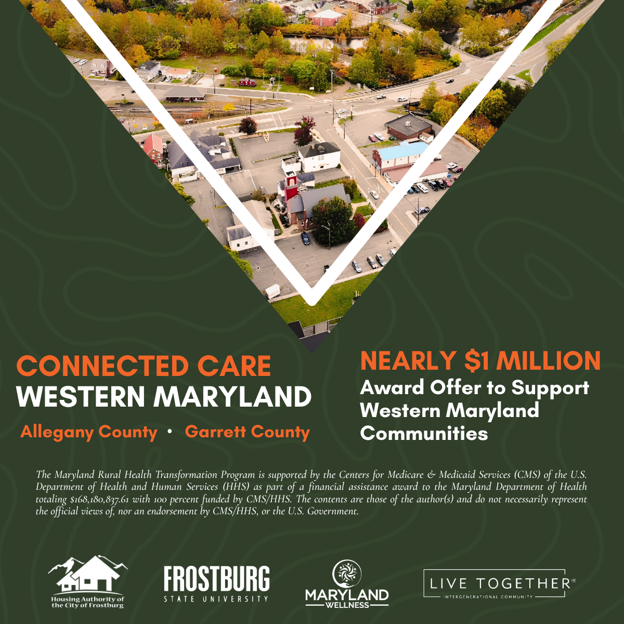
FROSTBURG, Md. — The Housing Authority of the City of Frostburg, in collaboration with Frostburg State University Social Work Program, Maryland Wellness and Live Together, Inc., has been selected to receive an award offer of nearly $1 million through Maryland's Rural Health Transformation Program, pending execution of a final agreement with the Maryland Department of Health, to launch Connected Care Western Maryland: Building Trust Through Care, Access, and Community.
Funded under Pillar 2: Promote Sustainable Access and Innovative Care Transformation Funds, the initiative will address barriers to health and behavioral health care across rural Allegany and Garrett counties, including provider shortages, transportation, geographic isolation and health literacy.
“This award offer is an investment in both the health of our community and the partnerships that make meaningful change possible,” said Ashley Lane, LMSW, Executive Director, Housing Authority of the City of Frostburg. “By bringing organizations with different strengths together, we can address barriers in a more coordinated way and build solutions that are rooted in the needs of Western Maryland.”
Pending execution of the final agreement, the initial funding period is expected to run from August 2026 through June 2027 and will support the development of a Community Wellness Hub at Meshach Frost Village, expanded behavioral health services and community outreach, a new microtransit initiative to improve transportation access, and development of a rural health workforce pipeline in partnership with Frostburg State University.
Maryland Wellness will lead behavioral health implementation, including outpatient therapy, psychiatric medication management, psychiatric rehabilitation, substance use disorder treatment, peer support and telehealth access, while also supporting community outreach and behavioral health awareness efforts.
“Access to behavioral health care is about more than having a provider available,” said Dr. Jon D’Souza, MD, CEO, Maryland Wellness. “Transportation, trust, awareness and the ability to navigate services all influence whether someone is able to get and stay connected to care. This collaboration gives us an opportunity to address those barriers together.”
“The micro-transit program transforms how rural communities access transportation, delivering flexible, efficient mobility solutions where they’re needed most,” said Jane Rohde, AIA, FIIDA, ASID, CHID, ACHA, EDAC, Founder, Live Together, Inc.
Frostburg State University will lead development of the initiative’s workforce component, creating pathways for students to gain hands-on experience serving rural communities while strengthening the pipeline of professionals prepared to live and work in Western Maryland.
“This initiative allows us to invest in the health of Western Maryland today while also preparing the workforce our communities will need tomorrow,” said Dr. Nancy Giunta, PhD, Associate Professor and Program Director of the Social Work Program at Frostburg State University. “By creating meaningful opportunities for students to learn alongside community partners, we can strengthen the connection between education and rural practice and help build a workforce that is prepared to serve Western Maryland for years to come.”
Pending execution of the final agreement, the collaborative will begin implementation during the current funding period and plans to pursue additional Rural Health Transformation funding as future opportunities become available.
For more information about Connected Care Western Maryland or for media inquiries, contact:
Ashley N. Lane, LMSW, C-PHM
Executive Director
Housing Authority of the City of Frostburg
alane@frostburghousing.org
(301) 689-9700
The Maryland Rural Health Transformation Program is supported by the Centers for Medicare & Medicaid Services (CMS) of the U.S. Department of Health and Human Services (HHS) as part of a financial assistance award to the Maryland Department of Health totaling $168,180,837.61 with 100 percent funded by CMS/HHS. The contents are those of the author(s) and do not necessarily represent the official views of, nor an endorsement by CMS/HHS, or the U.S. Government.